
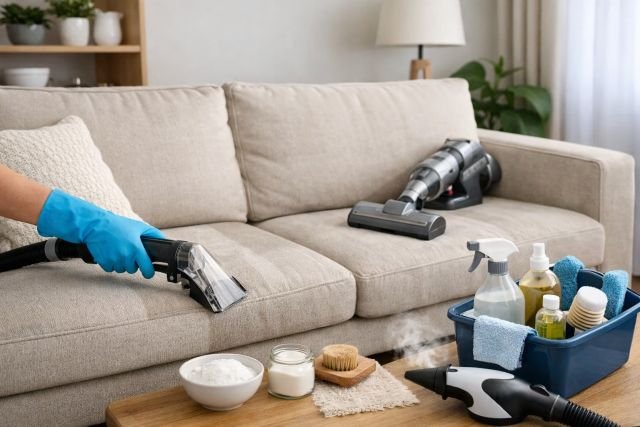
If you want to clean sofa couch upholstery at home, the best results come from doing things in the right order: remove dry grit first, treat stains second, and only then do a low-moisture deep clean. Most “my couch still looks dirty” stories happen because people jump straight to soap and water, which can spread oils, leave residue, or create water rings.
A cleaner sofa also supports a cleaner indoor environment. The U.S. EPA recommends using a vacuum (ideally with a HEPA filter) on carpets and fabric-covered furniture to reduce dust build-up. That’s not about perfection; it’s about reducing what settles into fibers over time.
What “deep-cleaning” a sofa actually means
Deep-cleaning is a complete reset of upholstery: thorough vacuuming, careful stain treatment, an even all-over clean that lifts oils and embedded soil, and then full drying. Drying matters as much as cleaning because moisture is a key driver of mold and musty odors. The EPA’s mold guide emphasizes that moisture control is the key and notes that water-damaged items should be dried within 24–48 hours to prevent mold growth.
Start here: find your upholstery cleaning code
Before you apply anything wet, look for the care tag under cushions or along the frame. Many sofas use these codes: W (water-based cleaners), S (solvent-only), WS/SW (either), and X (vacuum only). If you ignore the code, you can end up with dye bleed, rough texture, or rings. A clear overview of these codes and what they allow is summarized in upholstery-code explainers like Sailrite’s guide.
If you can’t find a tag, treat the fabric as sensitive and use the lowest-moisture option until you confirm what it is. When in doubt, the safer move is to clean less aggressively rather than gamble and permanently change the fabric.
Clean sofa couch checklist: the deep-clean order that works
Step 1: Do a “dry clean” first, and don’t rush it
This is where the transformation usually happens. Dry soil (dust, sand, crumbs) dulls fabric and grinds into fibers when you sit down. Vacuuming first prevents you from turning that grit into muddy smears during wet cleaning.
Use an upholstery attachment and slow passes, especially on arms, head-rest zones, and cushion seams. If you have allergies or asthma in the home, note the EPA’s guidance that people with asthma or allergies should leave the area being vacuumed, and that using a HEPA-filter vacuum on fabric-covered furniture helps reduce dust build-up.
Step 2: Spot-test any cleaner you plan to use
Pick a hidden spot (back panel, under a cushion). Apply your intended cleaner lightly, blot, and wait about 15 minutes. You’re looking for color transfer, fading, water marks, or texture change.
This step seems small, but it’s the difference between a clean couch and a “why is there a lighter square on my sofa now?” situation.
Step 3: Choose a method that matches your code
If your sofa is W, you can use a water-based upholstery cleaner, but low moisture still wins. You want barely damp cleaning, not soaking.
If your sofa is S, water can cause rings or damage, so stick to solvent-based upholstery products and ventilate well.
If your sofa is WS, you can use either approach, but it’s still smart to keep moisture controlled.
If your sofa is X, do not apply liquids. Focus on vacuuming and gentle brushing, and consider a pro for stains.
Step 4: The safest whole-sofa deep clean (low moisture, high payoff)
To deep clean without over-wetting, apply cleaner to a microfiber cloth rather than spraying the sofa. Work in small sections so you can control evenness and drying. Wipe with the fabric grain, then blot immediately with a dry towel.
For W/WS fabrics, do a second pass with a clean cloth lightly dampened with plain water to remove residue, then blot again. Residue is sneaky: it can attract soil and make the couch look re-dirty faster than you’d expect.
Step 5: Dry like you mean it
A couch can feel dry on top while still being damp deep in seams and cushion cores. That lingering moisture is what creates the “cleaned it yesterday and now it smells weird” effect.
Use airflow and time. Stand cushions on their edges so all sides dry evenly and run fans to move air across the surface. If your space is humid, a dehumidifier helps a lot.
Moisture guidance is consistent across public health sources: the CDC’s homeowner/renter mold guidance notes that if you can’t dry a home and contents (including furniture) within 24–48 hours after flooding, you should assume mold growth and focus on completely drying and removing water-damaged items. The takeaway for everyday couch cleaning is simpler: don’t leave upholstery damp for long.
Common stains: what to do without wrecking the fabric
Grease stains need a degreasing approach, but still within your fabric code. Blot first, then use a small amount of approved cleaner with short “dwell” time and repeated blotting. Grease often takes multiple gentle rounds instead of one aggressive scrub.
Coffee and tea stains respond well to careful blotting with a compatible cleaner. Avoid hot air until the stain is gone, because heat can set certain stains.
Ink is unpredictable because it can spread. Solvent-compatible fabrics (S or WS) often do better with solvent-appropriate products, but spot testing is non-negotiable here.
Pet accidents usually require enzyme cleaners to break down odor-causing residues. Choose an enzyme product that matches your code, and prioritize complete drying, because odor problems frequently persist when the inner cushion stays damp.
How often should you deep-clean upholstery?
Weekly vacuuming is a strong baseline for most homes, and it’s specifically called out in EPA asthma-trigger guidance for carpets and fabric-covered furniture. Deep-cleaning is typically a periodic reset, commonly every 6–12 months depending on use, kids, pets, and allergy needs.
When it’s smarter to hire a professional
If your sofa is coded S or X and you have a noticeable stain, professional cleaning is often safer than experimenting. Also consider a pro if you have widespread discoloration, persistent odor after proper drying, or any water damage scenario where cushions stayed wet too long.
On the moisture side, public health guidance consistently treats prolonged dampness as the risk factor, not just visible mold. EPA mold guidance emphasizes moisture control and timely drying to prevent growth.
Conclusion
To clean sofa couch upholstery at home and get that true “fresh reset” result, do it in the right sequence: vacuum thoroughly, spot-test, clean evenly with a fabric-code-safe method, and dry completely. The EPA’s guidance reinforces that vacuuming fabric-covered furniture helps reduce dust build-up, and mold guidance from agencies like the EPA and CDC makes it clear that moisture control and timely drying are central to preventing problems after things get wet. If you treat drying as part of the cleaning, your couch won’t just look cleaner — it will stay cleaner longer.