
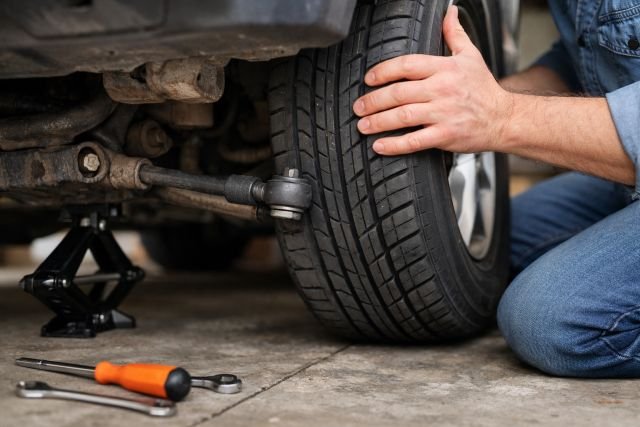
If your steering suddenly feels a little “off,” your tires are wearing unevenly, or you’ve started hearing a clunk when turning into a parking spot, a quick tie rod tie rod check can help you catch a safety issue early, often without any special tools.
Tie rods are part of your steering linkage. They connect the steering rack or steering gearbox to the steering knuckle at the wheel. When they wear, your wheels can toe in or toe out unpredictably, your alignment drifts, and the car may wander. In severe cases, a tie rod failure can mean a sudden loss of steering control, which is serious enough that regulators investigate steering defects and manufacturers issue recalls when patterns appear.
This guide walks you through an at-home inspection you can do in your driveway, how to interpret what you feel and hear, and when “monitor it” becomes “don’t drive it.”
What a tie rod does and why small wear matters
A tie rod assembly typically has an inner tie rod near the steering rack and an outer tie rod end at the wheel, where a ball-joint-like joint bolts to the steering knuckle. Together they translate steering rack movement into wheel angle while allowing suspension travel.
When a joint loosens, the wheel can change direction slightly without you turning the steering wheel. That is why early wear shows up as wandering, steering that feels vague, and tires that begin to wear on the inner or outer edges. Professional training and inspection standards include checking tie rod ends and steering boots because they are common wear points and can affect safe vehicle control.
Tie rod tie rod symptoms drivers notice first
Most people don’t find a bad tie rod by looking at it. They notice how the car behaves on the road, then trace the symptom back to the steering linkage.
One common sign is that the car drifts and requires constant small corrections to stay centered. Another is a clunk you can feel through the floor or steering wheel when you turn at low speed, pull into a driveway, or change direction from forward to reverse. A third is uneven tire wear that returns quickly even after an alignment, because an alignment cannot “hold” if a joint is moving. Torn boots or visible grease are also meaningful because contamination accelerates wear, and many inspection frameworks treat boot damage as a reason to take a closer look or replace the part depending on severity.
Safety before you test
If you lift the car, use jack stands on solid ground and never rely on a jack alone. Keep your hands clear of pinch points around suspension components. Avoid forcing movement with aggressive prying, because some manufacturer and component-maker procedures warn that the wrong technique can damage parts or create misleading results.
If anything feels dangerously loose, stop the test and plan for repair before driving again.
The no-lift driveway tie rod tie rod check
This is the quickest check and often catches obvious play. It also helps you decide whether it’s worth lifting the vehicle for a closer look.
Start with the vehicle parked on flat ground. Keep your foot on the brake and, if possible, have the engine running so power steering assistance is active. Ask a helper to gently rock the steering wheel left and right through a small range, roughly an inch or two at the rim, repeating the motion steadily.
While they do this, stand in a safe position and watch the front wheel area and listen. You are looking for a delay between steering input and wheel response, a visible “jump” at the joint, or an audible clicking or clunking that matches the steering rocking. Many professional inspection approaches begin with controlled steering input and visual confirmation because it makes looseness easier to detect.
If you see hesitation followed by a snap, or a repeating knock synced to the movement, treat that as a strong hint that a closer lifted-wheel check is needed.
The lifted-wheel shake test for a clearer answer
If you want a more confident at-home diagnosis, the lifted-wheel test is the most useful method. It won’t replace a shop’s measurement tools, but it can reveal play clearly.
Lift one front wheel and secure the vehicle on jack stands. With the wheel off the ground, grab the tire at the 3 and 9 o’clock positions and push and pull as if you are trying to steer the wheel by hand. A healthy system feels tight and moves as a unit. A worn outer tie rod end often produces a distinct click, and you may see movement at the knuckle connection.
Then confirm visually. Look behind the wheel at the outer tie rod end where it attaches to the steering knuckle. If the stud area shifts while the steering arm stays relatively still, that is play in the joint. Published inspection guidance generally focuses on feeling and observing unwanted movement, and some procedures caution against prying or applying force in ways that can distort the result.
How to tell inner tie rod wear from outer tie rod wear
It’s common to feel looseness and wonder which end is at fault. Outer tie rod ends are easier to identify because they are visible near the wheel, and their boots are exposed. If you can see movement at the joint where it bolts to the knuckle, or you see a torn outer boot or grease loss, the outer tie rod end is the most likely culprit.
Inner tie rods are closer to the steering rack and typically sit under a rack boot. When the outer end appears tight but the rod shifts near the rack boot area, inner tie rod wear becomes more likely. Many repair references note that inner tie rod problems can mimic outer tie rod symptoms and can be harder to spot visually, which is why watching for motion near the rack boot area matters.
The boot check that catches problems early
Even if you cannot conclusively feel looseness, the condition of the boots helps you judge risk. A torn outer tie rod boot can let water and grit into the joint, speeding wear. A damaged rack boot can expose the inner tie rod area to contamination and can also hide other issues. Professional task lists include inspecting steering bellows and boots as part of competent suspension and steering inspection.
If you see torn boots, treat that as a reason to inspect more carefully and plan for service sooner rather than later.
How much looseness is too much
For a home test, use a practical standard. If you can clearly feel a click, see visible joint movement, or reproduce a clunk consistently with the tests above, it is too much. Heavy-duty and fleet procedures sometimes use dial indicators and defined thresholds, but those tools and setups aren’t typical at home. Spicer’s inspection procedure, for example, describes a dial-indicator approach and warns about methods that can mislead or damage parts.
When steering is involved, “maybe” should be treated as “get it confirmed.”
Why this matters for safety
Tie rod issues are not just noise problems. Steering and suspension defects are taken seriously because they affect vehicle control. NHTSA maintains public resources for recalls, investigations, and safety data, and tie-rod-related investigations and recalls have occurred across the fleet when defects are suspected.
That doesn’t mean your vehicle is part of a recall. It means the failure mode is real enough that it’s tracked at the national level. Catching looseness early is the best way to avoid a situation where control becomes unpredictable.
What causes tie rods to wear faster
Normal mileage causes wear, but impacts and contamination accelerate it. Hitting potholes hard, tapping curbs during parking, driving with torn boots, and running modified suspension geometry without correction can shorten tie rod life. Installation quality matters too, because incorrect assembly practices can lead to premature looseness or noise. Parts manufacturers emphasize correct installation and inspection methods for reliability.
If you have replaced tie rods more than once in a short time, it is worth checking alignment settings, suspension modifications, and whether boots are staying intact.
What to do if your tie rod tie rod check suggests a problem
If your symptoms are mild and you cannot detect clear play, you may be able to drive carefully to a shop for confirmation. If you feel obvious looseness, hear repeatable clunks during the tests, or see visible movement at the joint, treat it as do-not-drive until it’s inspected or repaired.
After replacing tie rods, an alignment is typically required because toe is directly affected by tie rod length and position. Also, if one side has worn from age and mileage, the other side is often not far behind, so many repair guides discuss replacing in pairs to avoid repeating labor and alignment costs.
FAQ for featured snippets
What is a tie rod end
A tie rod end is the steering linkage joint at the outer end of the tie rod that connects to the steering knuckle and allows controlled movement as the suspension travels.
How do I check tie rod ends at home
Do a no-lift test by having a helper gently rock the steering wheel while you listen and watch for clicking or delayed wheel response. If you can safely lift the vehicle, confirm with the 3 and 9 o’clock wheel shake test and watch the outer tie rod end for visible movement.
What does a bad tie rod sound like
A worn tie rod often sounds like a clicking or clunking that repeats during low-speed turns, parking maneuvers, or quick steering direction changes.
Can a bad tie rod cause vibration
Yes. Looseness can create steering shimmy, and the misalignment it causes can accelerate tire wear and contribute to vibration.
What is the difference between inner and outer tie rods
The inner tie rod connects to the steering rack and is often hidden under the rack boot. The outer tie rod end connects to the steering knuckle at the wheel and is easier to see and test directly.
Conclusion
A tie rod tie rod check is one of the most useful steering safety checks you can do at home, because it helps you catch looseness before it turns into rapid tire wear or unpredictable steering. Start with the no-lift helper test, then confirm with the lifted 3-and-9 shake test if you can do it safely. If you hear clunks, see movement at the joint, or feel clear play, get it repaired and aligned as soon as possible. Steering problems are not the kind you want to “wait out,” and a simple check today can prevent a much bigger issue later.