
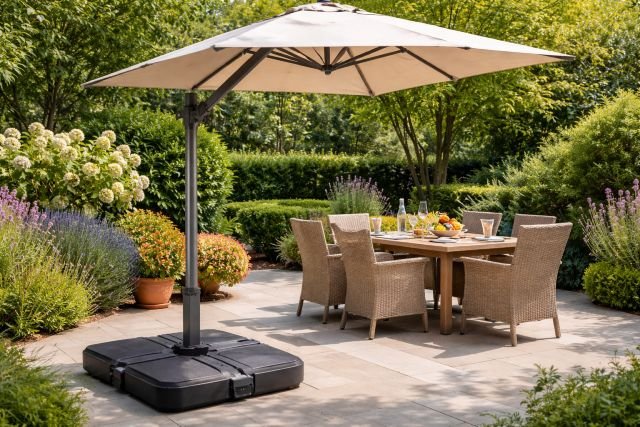
Outdoor dining should feel easy: comfortable shade, steady tables, and zero worry that a gust will turn your umbrella into a problem. That’s exactly what a well-built parasol base garden setup delivers. It isn’t just “a heavy thing on the ground.” It’s a stability plan that matches your canopy size, umbrella type, surface, and wind exposure, so your dining area stays safe and looks intentional.
This matters because unsecured umbrellas can become airborne in gusts and have caused severe injuries and even deaths in documented incidents. The U.S. Consumer Product Safety Commission has issued a safety alert warning about wind-driven umbrellas and the serious harm they can cause. Research using U.S. emergency department injury surveillance data has also examined beach and patio umbrella injuries, reinforcing that this is a real and preventable risk.
What “parasol base garden” actually means
A parasol base garden setup is the complete stability system for a parasol or patio umbrella in a garden dining space. It includes the base style, total weight, pole fit, locking mechanism, anchoring method, and placement strategy. When it’s done right, the umbrella behaves like it belongs there. When it’s done wrong, it wobbles, leans, and eventually tips or lifts.
Outdoor dining has specific challenges that make stability more important than in a lounge corner. People shift chairs, brush past the pole, and sometimes lean on the table while standing up. Any tiny sway gets amplified, especially with larger canopies. A secure setup is not only safer; it also improves the overall experience because the space feels more solid and premium.
The three forces behind a secure outdoor dining setup
A stable parasol setup always comes down to three things working together: resistance, grip, and leverage management.
Resistance is the base’s ability to oppose tipping, typically through mass and footprint. Grip is the connection between pole and base, including tube diameter and the quality of the collar clamp. Leverage management is placement: whether the table supports the pole, whether the umbrella is tilted, and how wind is allowed to flow through the canopy.
If one of these fails, the whole system feels unreliable. You can have a heavy base with poor grip and still get wobble. You can have a perfect clamp with too little resistance and still get tipping. And you can have both, then ruin it by placing a freestanding umbrella in a wind corridor with no anchoring.
The most secure parasol base garden configuration for dining tables
If your dining table has a center hole, the safest and most elegant setup is usually a center-pole umbrella that passes through the table and locks into a base beneath it. This design reduces wobble because the table acts as a stabilizer and shortens the “free” length of the pole that can flex.
Many base-sizing guides explicitly note that when a center-post umbrella fits through a table, you can often reduce the needed base weight because the table contributes stability. That doesn’t mean you should choose a tiny base. It means you can choose a base that’s appropriate rather than oversized, while still achieving a firm feel.
The key detail most people miss is the table opening. If the hole is wider than the pole and you don’t have a proper ring insert or collar, the pole will rattle. That rattle becomes wobble, and wobble becomes loosened hardware over time. Fixing the fit often makes an existing setup feel dramatically more secure without changing anything else.
When a heavy base is enough, and when anchoring is the safer answer
Portable weighted bases are popular because they feel simple. Put it down, tighten it, you’re done. For many home patios, that can work well if you size correctly and manage wind.
But for higher wind exposure, frequent use, or commercial dining, anchoring is often the most secure path. The reason is simple: freestanding umbrellas can experience strong leverage forces, especially when wind hits the canopy and the pole becomes a lever arm. Anchoring converts that leverage into resistance from the ground or structure rather than relying on portable mass alone.
The CPSC’s safety warning makes the underlying point obvious: wind gusts are unpredictable, and unsecured umbrellas can become dangerous. If you know your space gets gusts, anchoring is not an upgrade for aesthetics; it’s a safety decision.
In-ground sleeves for garden dining areas
If you have a garden dining spot that stays in one place, an in-ground sleeve can create an extremely secure parasol base garden setup with a clean look. It removes clutter around chair legs and makes it easier to walk around the table. It’s especially effective where people want a “built-in shade” feel without installing a permanent pergola.
This approach works best when you already know the exact shade location. The moment you start moving the table regularly, portability becomes more important, and a heavy base or rolling base may be more practical.
Deck or concrete anchor plates for patios and rooftops
Anchor plates bolted into concrete or properly reinforced decking are common in commercial settings because they keep walkways clear and reduce trip hazards. They also reduce staff time spent nudging bases into position. If you want a stable dining area with minimal visual noise, this is one of the cleanest solutions.
How to choose base weight with confidence
Most “how heavy should it be” questions come down to three variables: canopy size, whether the table supports the pole, and how exposed the area is to wind.
One practical rule-of-thumb cited by umbrella guides is that if a center-post umbrella is supported through a table, you can often use roughly five pounds per foot of canopy diameter because the table helps stabilize it. Without table support, you typically need a heavier base because all the leverage is handled at ground level.
This is also why offset and cantilever umbrellas demand much more stabilization. Their canopies sit off-center, which increases torque at the base. Many guides emphasize that cantilevers are more demanding than center-pole umbrellas because the side-arm design places greater stress on the base system.
If you want the secure feeling people notice immediately during outdoor dining, prioritize a base that is low and wide. A low center of gravity and larger footprint can feel steadier than a tall narrow base with the same weight.
Secure setups by umbrella type
Market umbrellas for classic outdoor dining
Market umbrellas are often the best match for dining because they integrate with a table hole and keep the pole centered. With the right collar fit and a properly sized base beneath, they can feel surprisingly stable.
The most secure arrangement is simple: table-supported center-pole umbrella, base centered beneath, and a tight collar or ring at the table opening to prevent rattle. When those three align, the umbrella stops feeling like a temporary add-on and starts feeling like a fixture.
Cantilever umbrellas for tables without center holes
Cantilever umbrellas are popular because they free up the middle of the table. They can also be very secure, but only when the base system is designed for cantilevers. The common mistake is buying a beautiful offset umbrella and pairing it with a generic base that was intended for a center pole.
Cantilever designs use side arms and create more stress at the base, which is why guides repeatedly highlight their increased stability requirements. In dining areas, that matters even more because people move chairs under the canopy and may brush the pole or mast.
The safest cantilever dining setup is one where the base system is purpose-built, the canopy is positioned to reduce direct wind catch, and the umbrella is closed promptly when the area is unattended.
Commercial patios and high-traffic outdoor dining
In restaurants and cafés, stability is only one part of the goal. The other part is reducing obstacles. Heavy rolling bases can create trip points and narrow walkways. In these environments, anchored mounts and clean placement often deliver the best combination of safety and usability.
If you run a commercial dining area, your parasol base garden setup should also include an operating habit: close umbrellas when wind rises or when staff is not actively monitoring the area. The CPSC safety alert’s focus on gust-driven incidents supports the idea that “leave it open and hope” is not a policy.
Wind-proofing tips that keep your dining area elegant
Wind safety is not only about extreme weather. It’s about routine gusts that appear during otherwise pleasant afternoons.
A secure setup starts with choosing a vented canopy when possible because vents help reduce uplift by allowing air to pass through instead of catching underneath. Next comes placement. If your dining area sits in a corridor between buildings, hedges, or walls, wind can accelerate through that channel and hit the canopy harder than you’d expect.
The most effective habit is also the simplest: close the umbrella when it’s unattended. That single behavior eliminates most “sudden gust” problems, and it aligns with safety messaging around airborne umbrellas.
Sun protection is part of “secure”: choose fabric that performs
If you’re building shade for outdoor dining, you want stability and meaningful UV protection. UPF is the clothing-and-fabric equivalent of sun protection performance, and it’s a helpful metric for comparing canopies.
Authoritative health sources and the Skin Cancer Foundation explain that UPF 50 fabric blocks about 98% of the sun’s rays and allows about 2% through. If your dining area gets midday use, UPF-rated canopy material is worth prioritizing because it turns “shade” into “protective shade.”
Real-world scenarios that show what works
A backyard host notices their umbrella feels shaky during meals, especially when guests push chairs back. They assume they need a heavier base. In many cases, the bigger problem is the pole fit at the table opening. Once they add a properly sized ring insert and tighten the collar so the pole can’t rattle, the whole setup feels sturdier without changing the base.
A rooftop dining area installs an offset umbrella for a table without a center hole. It looks amazing, but the wind is unpredictable. They switch to a cantilever-rated base system and adopt a simple operating rule: close the canopy whenever staff are not actively on the terrace. The dining space becomes calmer, and the umbrella stops being a constant worry.
A café patio struggles with heavy bases blocking walkways. They move key shade points to anchored mounts, which improves safety and service flow. Guests stop bumping into bases, and staff stop spending time repositioning them.
FAQ
What is the best base for a garden parasol over a dining table?
For most homes, the most secure option is a center-pole umbrella supported through the table and secured into a properly sized base beneath it, with a snug collar ring at the table opening to prevent pole rattle. Guides note that table support can reduce the base weight required because the table contributes stability.
How heavy should a parasol base be for outdoor dining?
It depends on canopy size, wind exposure, and whether the umbrella is supported through a table. When the umbrella is table-supported, guides often suggest lower base weight needs than when the umbrella is freestanding, and they emphasize that exposed areas require more stability.
Are cantilever umbrellas safe for dining areas?
Yes, if you use a base system designed for cantilevers and you treat wind management as part of the setup. Cantilever designs place more stress on the base because the canopy is offset, which is why stability requirements are higher than for center-pole umbrellas.
Do patio umbrellas really cause injuries?
They can. The U.S. CPSC has warned that wind gusts can send umbrellas airborne, causing severe injuries and even deaths, and research has examined beach and patio umbrella injuries treated in U.S. emergency departments.
Conclusion
A secure parasol base garden setup for outdoor dining is a system, not a single product. The most stable dining configuration is usually a center-pole umbrella supported through a table with a correctly fitted collar and a properly sized base beneath it. For exposed spaces, rooftops, and commercial patios, anchoring can be the safer choice because it controls leverage more effectively and keeps walkways clear. Wind habits matter as much as hardware, and UPF-rated canopies add real value by turning shade into dependable sun protection.