
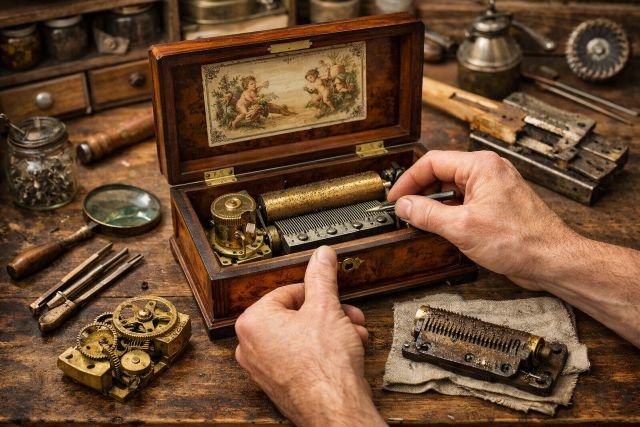
An antique music box is one of those objects that feels alive. You wind it, you hear the mechanism “wake up,” and suddenly a melody from another century is playing in your living room. That magic is exactly why restoration can be so emotionally loaded — and why it’s easy to make the wrong move. A music box isn’t like a chair you can sand and refinish until it looks fresh. Its sound depends on microscopic relationships between parts: the speed of the train, the alignment of the comb, the condition of the pins, and the friction at pivots that were designed for a very specific kind of lubrication.
This guide is designed to help you restore an antique music box without restoring away its value. You’ll learn what repairs are usually worth doing, what “improvements” to avoid, and what restoration tends to cost in the real world. Along the way, you’ll also get the mental checklist professionals use: stabilize first, restore function safely, and treat cosmetics as a separate decision — because the prettiest refinish in the world won’t matter if you’ve damaged the voice of the instrument.
What restoration really means for an antique music box
People use the word “restoration” to mean everything from a quick cleaning to a full rebuild. For antiques, it’s more helpful to think in terms of intent.
One approach is conservation-oriented: you aim for minimal intervention, preserving historical surfaces and making changes that don’t erase what’s original. The U.S. National Park Service’s museum guidance, for example, emphasizes minimal intervention to reduce the risk of compromising an object’s significance or causing unintended damage later. That philosophy translates cleanly to a music box because over-restoration is one of the most common value-killers.
A second approach is functional restoration: you want the music box to play properly and safely, with correct tempo and clean tone. This may require deeper mechanical work, especially if lubrication has hardened, the governor is sticking, or the mainspring is failing.
A third approach is cosmetic restoration: case refinishing, veneer repairs, polishing metal surfaces, replacing missing trim, or “making it look new.” This can be appropriate in certain situations, but it’s also where irreversible decisions happen, so it’s typically safest to postpone cosmetic changes until the mechanism is stable and you understand the box’s collector value.
How an antique music box makes sound and why it changes your repair choices
Most classic boxes create music when a pinned cylinder (or a raised-projection disc) rotates and plucks the tuned teeth of a steel comb. The motor is usually spring-driven, and a governor regulates speed so the melody stays in time. When any part of that chain is off — power delivery, friction, speed regulation, alignment, or cleanliness — the sound will tell on you.
That’s why restoration isn’t “just cleaning.” If speed is inconsistent, the melody feels anxious or sluggish. If the comb is misaligned, notes buzz or go quiet. If old oil has turned to varnish, the movement strains, wears faster, and may stall. The “right” fix depends on which symptom is actually the cause.
What to fix first in antique music box restoration
Start with stabilization, not upgrades
If your antique music box hasn’t been serviced in decades, the first goal is almost always to stabilize: stop active wear and prevent damage during operation. That usually means addressing hardened lubricants, grime, and friction points before you start chasing perfect tone.
A good restorer treats the mechanism like a precision timepiece: clean away old residue in a controlled way, then lubricate the correct points sparingly. It’s not glamorous, but it’s the foundation for everything else.
Cleaning and lubrication, done conservatively
Old lubricants can harden and behave like glue. That raises friction at pivots, makes the gear train inefficient, and forces the spring to work harder than it should. A proper service removes that old residue and replaces it with appropriate lubrication on the right surfaces.
Where DIY goes wrong is “oiling everything.” Multiple repair guides warn not to lubricate the cylinder or the comb contact area, because oil attracts dust and contamination, which can then increase wear and degrade sound. One repair article puts it plainly: do not lubricate the cylinder or comb, and limit lubrication to gears and the flywheel/governor area. That single caution can save you from turning a working antique into a noisy, gritty mechanism that needs a more expensive teardown later.
Governor service for tempo and reliability
If a music box plays too fast, too slow, surges in tempo, or struggles to “take off” when started, the governor is a prime suspect. Intertique’s repair guidance specifically discusses governor problems and how friction or wear in that assembly can stop the motor from running correctly.
The key insight is that speed problems often aren’t fixed by “bending something until it sounds right.” They’re fixed by diagnosing the underlying friction, contamination, or wear that’s preventing stable regulation. When the governor is clean and running freely, the entire mechanism becomes easier on itself, and the music becomes more predictable.
Mainspring and winding safety
Power is everything. If the mainspring is weak, damaged, dirty, or improperly lubricated, you’ll see symptoms like short play time, stalling, or inconsistent force delivery. Spring work is also one of the areas where an otherwise careful DIYer can get hurt or damage the plates/arbors because stored energy can release suddenly.
If your box resists winding, makes grinding sounds, or “snaps” in a way that feels wrong, stop. A professional assessment is often cheaper than replacing damaged gears or repairing a torn spring barrel later.
Alignment and note quality: comb, pins, and clearances
Dead notes, buzzing, or thin sound often leads people straight into panic-mode “tuning.” In reality, many note problems come from simpler causes: dirt between teeth, slight misalignment, or loosened fasteners. Cleaning debris from the comb and checking mounting stability can restore clarity without touching pins or teeth.
That said, comb and cylinder/disc geometry is extremely unforgiving. If teeth are bent or a pin is damaged, correcting it without experience can make things worse. Treat note work like dental work: yes, you can do it yourself, but the cost of a mistake is far higher than the cost of a proper evaluation.
Case structure: protect the mechanism by protecting the box
The case isn’t just decoration. Loose joints, shifting mounts, warped lids, and unstable bases can transmit shock to the movement and disrupt alignment over time. If the case is cracking or the mechanism mounting is loose, stabilizing the structure is a functional repair, not a cosmetic one.
If you’re choosing between making the case shiny and making the mounts secure, choose secure every time. A beautiful finish won’t matter if the mechanism is gradually vibrating itself out of correct alignment.
What to avoid when restoring an antique music box
Avoid indiscriminate polishing of metal parts
Highly polished metal can look impressive, but aggressive polishing removes original surfaces, softens edges, and can erase marks that help identify originality. It can also subtly change fits at friction points. In the antique world, “too new” often reads as “too altered,” and that can reduce collector appeal.
Avoid replacing original parts unless it’s truly necessary
Parts replacement can be appropriate when a component is broken beyond repair, but it should never be the default. Music House Shop’s parts guidance notes that certain parts can still be available, but also emphasizes that cylinders and their combs are tune-specific and must match each other. That’s a big deal: mismatched or “close enough” parts can permanently change the voice and authenticity of your antique music box.
If a restorer proposes swapping major components casually, ask how they plan to preserve tune correctness and what documentation you’ll receive. For higher-value pieces, keeping original parts (even if repaired) is often the more value-preserving route.
Avoid oiling the cylinder or comb contact area
This is worth repeating because it’s so common. Oiling the wrong area invites dust, which turns into abrasive residue. The result is increased wear and degraded sound. Again, a repair guide explicitly warns against lubricating the cylinder or comb and limits lubrication to gears and the flywheel/governor area.
Avoid sanding and refinishing the case “just because”
Full refinishing can erase patina, alter color, and remove original finishes that collectors value. Sometimes refinishing is justified — especially if the finish is actively failing and exposing the wood to damage — but it should be a deliberate decision, not the default “restoration step.”
If your goal is resale value, over-refinishing is one of the easiest ways to reduce it. If your goal is personal enjoyment, you can still often get a beautiful result through careful cleaning and localized conservation rather than stripping everything down.
Avoid bending pins or comb teeth as a first attempt at “tuning”
Pins and teeth are precision features. Bending them without a clear method can create a chain of new problems: buzzes that weren’t there before, wrong notes, broken teeth, or pins that catch instead of pluck. If your music box is rare or has strong collector value, this is the moment to step back and consider professional help.
Antique music box restoration costs: what it typically runs and why it varies
The honest answer is that restoration costs vary widely because labor dominates the bill, and labor depends on complexity, condition, and rarity.
You can anchor your expectations with two real-world reference points. Intertique provides an estimate of $300 to regulate dampers in average condition on an average-size Swiss or disc box. That’s a helpful benchmark because damper work is not a full rebuild, yet it’s still skilled labor.
For labor rates, Music House Shop lists labor at $75 per hour (or part thereof) for repair/restoration service. Shops vary, but seeing an explicit hourly rate gives you a realistic way to budget: a “simple” job that takes three to five hours quickly becomes a few hundred dollars, and deeper mechanical work can go higher.
From there, the costs tend to scale based on what the box needs. A controlled cleaning and correct lubrication might be several hours. Governor diagnosis and correction can add time, especially if wear or polishing work is needed to restore smooth function. Spring work often adds more labor because it’s more disassembly-intensive and higher risk. Comb or tooth repair can become expensive because it’s delicate, slow, and highly specialized.
There are also practical add-ons that surprise people: shipping and insurance for a delicate antique, potential bench/diagnostic charges if you decline the repair, and time-consuming parts sourcing for tune-specific components. Music House Shop even notes that a bench charge may apply in some cases depending on diagnosis labor, though policies vary by shop.
The best way to keep costs sensible is to define your target outcome before you authorize work. Do you want it to play safely? Do you want it to sound as correct as possible? Do you want a museum-like preservation of surfaces? Or do you want a visual makeover for display? Those are different jobs, and your estimate should reflect the goal.
A decision mindset that protects value
If you want one practical rule: treat your antique music box like a historic object first and a home décor item second. Conservation ethics emphasize minimal intervention to preserve significance and reduce unintended harm. When you apply that mindset, you naturally prioritize cleaning, correct lubrication, and mechanical health, and you become much more cautious about irreversible cosmetic work.
This approach also makes your conversations with repair shops better. Instead of asking, “Can you restore it?” you can say, “I want it stabilized and playing safely, with minimal changes to original surfaces. If parts must be replaced, I want that documented, and I’d like original parts returned.” The clearer you are, the less likely you are to get an over-restored result that looks shiny but lost its authenticity.
How to choose the right restorer for an antique music box
A good restorer will talk to you about originality, not just appearance. They’ll explain what they plan to clean, what they plan to lubricate, and what they will not touch without consent. They’ll also know the difference between cylinder and disc systems and how tune specificity affects parts choices.
It helps to start with specialists who explicitly work on antique cylinder and disc boxes and who describe both mechanical restoration and case work. For example, MusicBoxRestorations.com presents itself as specializing in antique disc and cylinder mechanism restoration and case refinishing, and Meekins describes decades of experience repairing and restoring antique disc and cylinder music boxes, including fabricating gears. Even if you don’t use those specific shops, that’s the kind of scope statement you want to see: evidence that they’re dealing with antiques, not only modern novelty movements.
When you request an estimate, expect questions. A careful shop often wants photos, maker information, and symptom descriptions. That’s not bureaucracy; that’s how they avoid guessing and how you avoid paying for unnecessary work.
Real-world scenarios and what they usually mean
If your antique music box plays but sounds sluggish and inconsistent, the cause is often old lubricant and friction, sometimes coupled with governor drag. That’s a stabilization-style repair: controlled cleaning and correct lubrication, plus governor servicing if needed. Intertique’s notes on governor issues align with the idea that regulation problems can prevent a motor from running reliably.
If the box winds but won’t start, don’t force it. The safest move is to stop and diagnose, because forcing a stalled train can damage gears. Many “won’t play” guides point to speed regulation and debris-related sound issues, but the correct fix still depends on identifying whether the failure is power, friction, or regulation.
If you have buzzing notes or silent notes, resist the urge to bend anything. Start by checking for debris and looseness, and consider professional evaluation if the problem persists. This is where people accidentally turn a repairable issue into a difficult one.
FAQ: Antique music box restoration
How do I know if my antique music box is worth restoring?
If the box has sentimental value, clear maker identification, rare features, or a higher-end mechanism, restoration is often worth it. Even when resale value is uncertain, stabilizing the mechanism can prevent further deterioration and preserve it for the next generation. If you’re thinking financially, get a conservative estimate first and compare it to the market value of similar boxes in working condition, then decide what “worth it” means for you.
Can I lubricate my antique music box myself?
It’s risky unless you understand where lubrication belongs. One repair guide explicitly warns not to lubricate the cylinder or the comb, and recommends limiting lubrication to gears and the flywheel/governor area. Incorrect lubrication can attract dust and increase wear, creating larger repair needs later.
What does antique music box restoration cost?
Costs depend on labor time, complexity, and parts. As a real-world reference, Intertique estimates $300 for damper regulation on an average-size Swiss or disc box. For labor rates, one repair service lists $75/hour (or part thereof), which helps you budget: multiple hours of skilled work quickly becomes several hundred dollars, and major mechanical repairs can go higher.
Is refinishing the case a good idea?
Not automatically. Refinishing can reduce originality and collector appeal, especially if it removes patina and original finish characteristics. If the finish is actively failing and exposing wood to damage, conservation-minded repair or partial restoration may be a better compromise than stripping everything.
What should I never do to an antique music box?
Avoid oiling the cylinder/comb contact area, avoid bending pins or comb teeth to “tune,” avoid aggressive polishing that erases originality, and avoid replacing tune-specific components without understanding matching requirements. Music House Shop specifically notes that cylinders and combs are tune-specific and need to match each other.
Conclusion
Restoring an antique music box is about protecting a voice, not just repairing a mechanism. The safest path is to stabilize first: remove old grime and hardened lubricants in a controlled way, lubricate only where appropriate, and make sure the governor and power delivery are healthy before you chase perfect sound. Avoid the temptation to “improve” it with indiscriminate polishing, heavy refinishing, or casual parts swapping — especially when tune-specific matching matters.
If you keep a conservation mindset — minimal intervention and respect for original fabric — you’ll end up with a music box that plays more reliably while retaining the authenticity that makes an antique worth owning.