
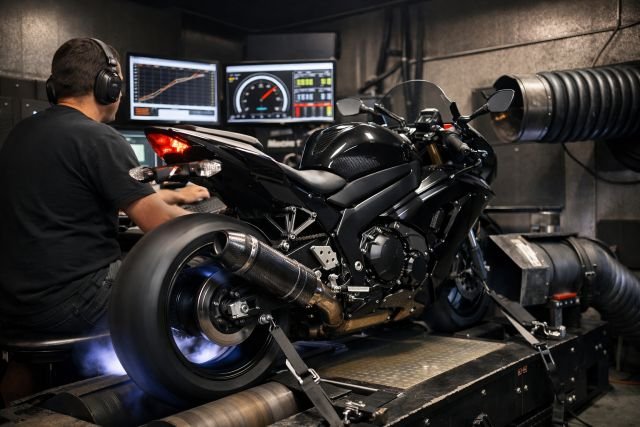
Searching for motorcycle dyno tuning near me usually means one thing: your bike isn’t running the way it should, and you want results quickly. Maybe you’ve added a slip-on or full exhaust and the throttle feels choppy. Maybe the bike runs hot, pops on decel, or has a flat spot in the midrange. Or maybe you just want to unlock smoother power and safer fueling without guessing.
A professional dyno tune can solve those problems fast because it measures exactly what your motorcycle is doing under load, then adjusts fueling and sometimes ignition timing to match your setup. Instead of relying on generic “one-size-fits-all” maps, dyno tuning builds a custom tune for your bike, your mods, and your riding goals. It’s one of the most reliable ways to improve rideability and performance, especially after intake and exhaust changes.
This complete guide will help you understand what dyno tuning is, how it works, what it costs, how to choose the right shop near you, and how to get the best result in one session.
What Is Motorcycle Dyno Tuning?
Motorcycle dyno tuning is the process of measuring your bike’s power output on a dynamometer while adjusting fueling and, when applicable, ignition timing to improve performance, safety, and ride quality. The dyno applies controlled resistance so your engine runs under realistic load conditions while sensors and software track data like horsepower, torque, throttle position, and air-fuel ratio.
The biggest advantage is accuracy. A dyno tune gives a tuner repeatable conditions to identify where your bike runs lean or rich, where torque drops, and how changes in your fuel map affect real power. That’s why dyno tuning is widely described as one of the most effective ways to optimize a modified motorcycle.
Why Riders Search “Motorcycle Dyno Tuning Near Me”
Most riders don’t wake up thinking, “I’d love to spend money on dyno time.” They search for motorcycle dyno tuning near me because they feel a problem and want a fix that works.
If your bike has an aftermarket exhaust, a high-flow air filter, velocity stacks, or any modification that changes airflow, your stock fuel map may no longer match. When airflow changes but fueling doesn’t, the engine can run lean in key areas, which often shows up as hesitation, surging, hard starting, excessive heat, or popping on deceleration. Dynojet tuning resources and tuning shops often point out that bolt-on mods frequently cause lean spots in the midrange because the ECU isn’t programmed to compensate for the extra airflow.
Dyno tuning is also popular because it improves the overall feel of the bike. Even when horsepower gains are modest, throttle response and smoothness can improve dramatically, which many riders feel more than they measure.
Motorcycle Dyno Tuning Near Me: What Happens During a Dyno Session?
A professional dyno session usually follows a structured process. It’s designed to be repeatable and data-driven rather than guesswork.
First, the bike is strapped down securely and warmed up to operating temperature. Then the tuner performs baseline runs to see what your bike is doing before changes are made. These baseline runs show horsepower and torque curves and, most importantly, reveal the air-fuel ratio across the RPM range.
Next comes the tuning phase. Depending on your bike and the shop’s approach, the tuner may adjust fueling using a piggyback fuel controller like a Dynojet Power Commander, or by flashing the ECU directly. Dynojet describes the Power Commander as a tool that optimizes air/fuel ratio without directly changing the ECU, which makes it common on many fuel-injected bikes.
Once adjustments are made, the tuner repeats dyno pulls to confirm improvements. This is where dyno tuning shines: you can see exactly how changes affect the air-fuel ratio and the power curve in real time.
The Air-Fuel Ratio (AFR) Explained in Plain English
Air-fuel ratio, often called AFR, is the relationship between how much air and fuel your engine is burning at any moment. It matters because it affects power, throttle response, temperature, and engine safety.
For gasoline engines, the “stoichiometric” ideal — where the fuel and oxygen theoretically burn completely—is about 14.6:1, meaning 14.6 parts air to 1 part fuel. That’s a common reference point and is frequently cited in engine tuning education resources.
However, maximum power usually requires a richer mixture than stoichiometric. Tuners often target richer AFR values under heavy load to keep combustion stable and temperatures safer. Wideband oxygen sensors make this possible because they can measure AFR precisely across a wide range, unlike narrowband sensors which only indicate lean or rich relative to stoich.
This is why dyno tuning is so valuable. It uses wideband feedback and controlled conditions to dial in the AFR range that gives you the balance you want between performance and reliability.
How Much Power Can Dyno Tuning Add?
This is the most searched question—and the answer depends on your setup.
If your bike is stock, gains are often modest because manufacturers tune to meet emissions and reliability goals while keeping a safety margin. You may still feel improvements in throttle smoothness and midrange response, but peak horsepower gains may be smaller.
If your bike has intake and exhaust modifications, dyno tuning can make a bigger difference. That’s because bolt-ons change airflow, and correcting fueling restores efficiency and can unlock power that was being lost to incorrect AFR. Most performance shops describe dyno tuning as a way to maximize what your modifications can deliver rather than a magic horsepower hack.
What matters more than the number is how the bike rides. Riders usually notice the biggest improvement in the midrange, where street riding happens most.
Dyno Tuning vs. Mail-Order Maps: Which Is Better?
Mail-order maps and downloadable tunes are common, especially for popular exhaust and intake combos. They can work well as a starting point, and for many riders they feel “good enough.”
But a dyno tune is different because it’s built specifically for your bike and your environment. Two identical bikes with the same exhaust can still run differently due to differences in fuel quality, sensor wear, altitude, temperature, and manufacturing tolerances. That’s why many tuners treat off-the-shelf maps as a baseline and dyno time as the final refinement.
A custom dyno tune is usually best when you want peak rideability and safety, when you’ve made significant modifications, or when you’re trying to solve an issue that generic maps can’t fix.
ECU Flash vs. Piggyback Fuel Controller: What’s the Difference?
If you’re researching motorcycle dyno tuning near me, you’ll likely see two main tuning approaches.
A piggyback system like a Power Commander modifies fueling by intercepting signals and adjusting fuel delivery without rewriting the ECU itself. Dynojet explains the Power Commander approach as adjusting fueling in a way that optimizes AFR while avoiding direct ECU changes.
An ECU flash rewrites portions of the ECU’s programming. This can allow deeper control and can sometimes improve features like throttle mapping, fan temperature settings, and ignition timing in ways a piggyback may not. However, it also depends heavily on the tuner’s skill and the availability of reliable ECU definitions for your model.
A good shop will recommend the approach that matches your bike and your goals, not just the one they like best.
Signs Your Bike Needs Dyno Tuning
Most bikes will tell you when tuning is needed. The most common signs include a flat spot in acceleration, jerky throttle response at steady cruise, overheating tendencies, backfiring or popping after an exhaust change, poor fuel economy after mods, and a general feeling that the bike runs “off” after bolt-ons.
If you’ve made modifications and your bike feels worse instead of better, that’s one of the clearest signs that tuning is required. It usually means airflow increased but fueling didn’t.
How to Choose the Best Motorcycle Dyno Tuning Shop Near You
When people search motorcycle dyno tuning near me, the biggest mistake is choosing solely based on price. Dyno tuning is part science, part skill, and the tuner matters more than the dyno brand.
A trustworthy shop usually has experience with your type of bike, whether sportbike, Harley, ADV, or dirt bike. They should explain their process clearly, show real dyno graphs, and discuss how they monitor AFR with wideband sensors.
You should also look for a shop that asks questions about your fuel type, riding style, and modifications. If a tuner doesn’t care what fuel you run or whether your exhaust is decatted, that can be a red flag.
Finally, reviews matter, but pay attention to what the reviews say. “Made my bike feel smoother” is often more meaningful than “gained 5 horsepower,” because smooth fueling is usually the real win.
How Much Does Motorcycle Dyno Tuning Cost?
Costs vary by location, bike type, and what’s included. Some shops charge hourly dyno time, while others offer package pricing for a full tune. You’ll often pay more if you need additional hardware, such as a piggyback fuel controller, wideband module, or ECU flash license.
The most cost-effective way to approach dyno tuning is to show up prepared, with your modifications already installed, your bike mechanically sound, and no check-engine lights. If a session turns into troubleshooting, time increases and cost follows.
How to Prepare Your Motorcycle for Dyno Tuning
Preparation is how you get the best tune in the least time.
Make sure the bike has fresh fuel, the chain is adjusted correctly, and tires are in good condition. If your bike has a known issue like a misfire, vacuum leak, or failing coil, fix it first. Dyno tuning can’t solve mechanical problems; it will only expose them.
If you’ve installed an exhaust or intake, double-check there are no exhaust leaks, because leaks can skew AFR readings and cause inaccurate tuning decisions.
Also, tell the shop what you want. A track-focused tune may prioritize aggressive fueling and throttle response, while a touring tune may aim for smoothness and fuel economy at cruise.
Legal and Emissions Considerations You Should Know
This part matters, especially in regions with emissions inspections.
In the U.S., the EPA has repeatedly emphasized that tampering with emissions controls or installing defeat devices is illegal and can lead to enforcement actions and penalties. Their enforcement alerts explain that removing or disabling emissions equipment undermines emissions controls and can be costly for businesses and regulated entities.
That doesn’t mean dyno tuning itself is illegal. Dyno tuning is a method of calibration. The legal risk often comes from hardware changes like removing catalytic converters or disabling emissions systems, depending on local laws. A reputable shop should be transparent about compliance and will explain what is and isn’t allowed in your area.
Real-World Scenario: What Dyno Tuning Fixes Fast
Imagine you install a full exhaust and high-flow filter on your 600cc sportbike. It sounds incredible, but the bike now surges at steady throttle and feels weak between 4,000 and 7,000 RPM. You assume the exhaust caused a “loss of backpressure,” but what’s happening is more likely a lean fueling area where airflow increased and fuel didn’t.
A dyno session identifies that lean midrange and adds the fuel needed for stable combustion, restoring torque where the bike is ridden most often. That’s why dyno tuning often feels like a transformation. It makes the bike consistent, predictable, and smoother — not just louder.
FAQ: Motorcycle Dyno Tuning Near Me
What does motorcycle dyno tuning actually do?
It measures horsepower, torque, and AFR under load, then adjusts fueling (and sometimes ignition timing) to optimize performance and smoothness.
Is dyno tuning worth it on a stock motorcycle?
It can be, especially if you want smoother throttle response, but the biggest gains usually come after intake or exhaust modifications.
How long does a dyno tune take?
Many tunes can be completed in a few hours if the bike is healthy and modifications are already installed. If troubleshooting is needed, time increases.
Will dyno tuning improve fuel economy?
Sometimes, especially if the bike was running excessively rich or lean in cruising areas. However, aggressive performance tuning can reduce fuel economy depending on targets.
Do I need a Power Commander for dyno tuning?
Not always. Some bikes are tuned through ECU flashing, while others use piggyback controllers like a Power Commander to adjust fueling without changing the ECU directly.
Can dyno tuning fix popping on deceleration?
Often yes, especially if the popping is caused by a lean condition after exhaust modifications. However, exhaust leaks can also cause popping, so diagnosis matters.
Conclusion: Motorcycle Dyno Tuning Near Me Is the Fastest Way to Fix Fueling and Unlock Real Performance
If you’re typing motorcycle dyno tuning near me, you’re already on the right track. Dyno tuning is one of the fastest and most accurate ways to correct fueling after modifications, improve throttle response, smooth out flat spots, and make your bike feel stronger where it counts. By measuring AFR under load with wideband sensors and making controlled changes, a professional tune delivers results you can feel immediately.
The best results come from choosing an experienced shop, preparing your motorcycle properly, and being clear about your goals. Whether you’re chasing more usable power, solving rideability issues, or simply making your bike safer after bolt-ons, motorcycle dyno tuning near me is a high-impact upgrade that pays off in every ride.