
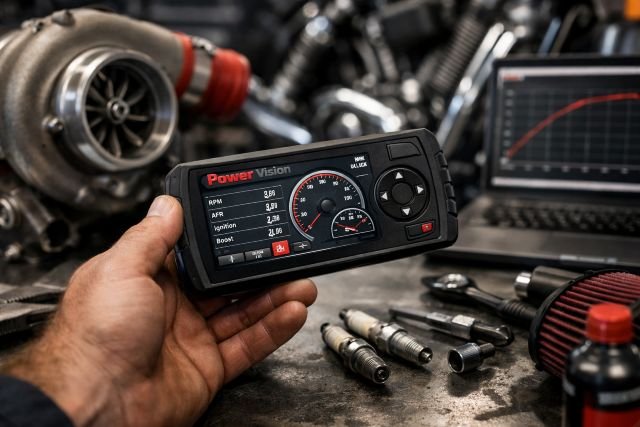
If you’re chasing stronger throttle response, smoother power delivery, and real horsepower gains, the power vision tuner is one of the most effective tools you can add to your performance setup. In the Harley-Davidson world especially, it’s become the go-to flash tuner because it can reflash the ECU, log real riding data, and help you build a tune that matches your exact combination of intake, exhaust, and engine modifications. Dynojet positions Power Vision as a device that can update your air/fuel ratio, monitor performance, and work as a diagnostic tool, which is why it’s widely used by both DIY riders and professional tuners.
But here’s the truth: owning a tuner doesn’t automatically mean big power. The horsepower gains come from making the right changes in fuel mapping, ignition timing, and calibration strategy, and then verifying those changes with data logging. That’s where many riders either win big or get disappointed.
This guide breaks down exactly how to get the most from a power vision tuner, including the best settings approach for horsepower, how to think about target AFR, when to use AutoTune versus Target Tune, and how to avoid mistakes that can cost power or reliability.
What Is a Power Vision Tuner and Why It Works for Horsepower
A power vision tuner is primarily a flash tuner, meaning it rewrites calibration tables inside your ECU so your bike can deliver the correct fuel and timing for your exact airflow and engine demands. It also functions as a monitor and logger, allowing you to record engine data and refine your tune based on real riding conditions.
Dynojet describes Power Vision 3 as a device that ships with a wide range of tunes, can hold multiple tunes at once, tracks and monitors progress, installs via the diagnostic port, and can be used with Dynojet’s PowerCore Software Suite for deeper tuning changes.
That matters because horsepower gains don’t come from a single number or magic setting. They come from calibrating the ECU so your engine runs at the right air/fuel ratio, the right ignition timing, and the right fueling strategy under load. A good tune also improves drivability, which often feels like a power gain even before you measure it.
How Much Horsepower Can You Gain With a Power Vision Tuner?
Horsepower gains depend heavily on what modifications your bike already has. On a mostly stock setup, tuning gains tend to be modest but noticeable because the factory tune is designed around emissions, safety margins, and broad operating conditions. On bikes with intake and exhaust upgrades, the gains can be significant because airflow changes can push the factory calibration outside its ideal range.
The important concept is that a power vision tuner doesn’t “create” horsepower by itself. It allows your engine to make the power it’s capable of by fixing fueling and timing so combustion happens efficiently.
If you want a realistic expectation, think of the power vision tuner as the tool that unlocks the potential of your hardware. A high-flow intake, free-flowing exhaust, cam upgrade, and headwork can create real power, but without proper tuning your results will be inconsistent and sometimes worse than stock.
Best Settings Philosophy: What “Maximize Horsepower” Really Means
When riders ask for “the best settings,” what they usually mean is “the best tune strategy.” A strong horsepower tune typically prioritizes:
Running safely rich under full load so combustion is cool and stable
Using ignition timing that delivers peak torque without detonation
Maintaining smooth AFR transitions for throttle response
Correcting VE (volumetric efficiency) tables so fueling is accurate across RPM and load
The power vision tuner gives you the tools to do this because it allows reflashing, data logging, and in some setups closed-loop wideband control through Target Tune accessories.
Horsepower tuning is about reducing error and increasing consistency. When your ECU knows exactly how much air is flowing, it can inject the right fuel at the right time, which is how engines make repeatable power.
Power Vision Tuner AFR Targets: The Most Important Setting You’ll Make
If you only master one tuning concept, make it this one: your air/fuel ratio targets control both horsepower and safety.
Under full throttle and heavy load, most performance tuners target a richer AFR because it helps prevent detonation and keeps combustion temperatures manageable. Many tuning discussions and guides commonly reference a full power AFR around 12.8:1, with cruising closer to stoichiometric or leaner for economy, depending on the engine and setup.
The reason AFR matters is that horsepower is closely tied to combustion efficiency. Too lean under heavy load can increase heat and detonation risk. Too rich can cool the chamber but may reduce peak horsepower and create sluggish response.
A good power vision tuner approach is not picking a single AFR number. It’s building a table where cruising AFR supports smoothness and mileage, and wide-open throttle AFR supports torque and safety.
Fuel Moto’s explanation of Auto Tune highlights that Power Vision corrects the tune so what you command in the AFR table is what you actually get, which is why AFR targets matter so much.
Power Vision Tuner Ignition Timing: The Hidden Key to Torque and Horsepower
Fuel tuning is only half the story. The other half is timing.
Ignition timing determines where peak cylinder pressure happens in the power stroke. If timing is too conservative, power and throttle response suffer. If timing is too aggressive, you risk knock, high heat, and mechanical stress. The best timing curve depends on compression ratio, cam timing, fuel quality, and combustion chamber design.
This is why “copying someone else’s timing values” is one of the most common mistakes riders make. Even if the AFR targets are similar, timing needs are not universal.
The best practice with a power vision tuner is to start with a proven base map that matches your exact engine configuration, then refine timing gradually while watching for signs of knock and checking performance changes through consistent data logs or dyno verification.
The Best Power Vision Tuner Workflow for Real Horsepower Gains
Horsepower tuning is a process, not a one-time flash.
The highest success approach typically looks like this:
Start with the most accurate base tune you can find for your setup
Verify it with data logging to confirm AFR and throttle response are close
Use AutoTune or Target Tune to reduce fueling error
Refine ignition timing based on load, RPM, and real-world performance
Re-log and validate the change before making another adjustment
This process is reinforced in professional training material that emphasizes the objective of Power Vision as calibrating the ECM to match airflow changes and improve overall performance, mileage, and drivability.
The reason this workflow works is that it avoids “chasing the tune.” Riders who randomly change multiple tables at once often end up with inconsistent results and no clear understanding of what helped or hurt.
AutoTune vs Target Tune: Which One Maximizes Horsepower?
This is one of the most common questions around the power vision tuner because both features are associated with improved accuracy.
AutoTune is typically used to correct fuel tables by logging ride data and adjusting fueling toward your commanded AFR targets. Fuel Moto describes Auto Tune as a system where Power Vision sets up the tune, logs the data, and corrects it so the commanded AFR is achieved.
Target Tune is different because it’s designed to let the ECU interpret wideband O2 signals and actively achieve the target AFR specified in the commanded AFR table. Dynojet’s user guide for Target Tune describes it as an accessory that enables the ECU to use wideband signals to hit the target AFR.
If your goal is maximum horsepower, the best setup depends on how far you want to go. AutoTune can produce strong results for many riders, particularly if they have moderate upgrades and want a refined street tune. Target Tune often appeals to riders seeking continuous wideband control and maximum accuracy, particularly on high-performance builds where fueling errors under load can become costly.
Power Vision Tuner Best Settings for Different Riding Goals
The best horsepower tune is not always the best street tune for every rider.
A peak horsepower tune usually aims for aggressive torque and optimized fuel delivery at full load, often at the cost of fuel economy. A street performance tune balances strong midrange torque with smooth part-throttle fueling. A touring tune may prioritize mileage and cooler engine temps.
The key is that the power vision tuner allows you to store and switch between multiple tunes, so you can run a horsepower-focused map for spirited riding and a mileage-focused map for long trips. Dynojet notes that Power Vision 3 can hold multiple tunes at once, which supports this approach.
Data Logging: The Feature That Separates “Guessing” From Tuning
Data logging is where the power vision tuner becomes a real horsepower tool instead of just a device that flashes maps.
Without logs, most tuning adjustments are guesses. With logs, you can see:
Whether AFR actually matches your targets
How throttle position and load affect fueling
Where the engine transitions from closed-loop to open-loop
Whether spark timing correlates with torque changes
How consistent your tune is across conditions
Dynojet’s Power Vision manuals and training materials emphasize monitoring and logging as core strengths of these devices, including customizable gauge screens that can display channels like AFR and wideband.
If you want maximum horsepower, you need maximum consistency. Logging helps you eliminate the small errors that cost torque across the curve.
Common Mistakes That Reduce Horsepower With a Power Vision Tuner
Many riders lose power after tuning because they misunderstand what matters.
One mistake is running the bike too rich everywhere. Rich fueling can feel “safe,” but excessive richness can wash power and make throttle response dull.
Another mistake is leaving timing overly conservative after major airflow changes. If fueling is corrected but timing isn’t, the engine may run safely but leave torque on the table.
A third mistake is relying entirely on a generic “canned tune” that doesn’t match the exact combination of intake, exhaust, and engine work. Dynojet does offer tune libraries and many vendors provide tested maps, but the best results still come from matching the tune closely to the hardware and validating it with logs.
Real-World Scenario: What Maximizing Horsepower Looks Like
Imagine a rider with a Milwaukee-Eight setup running a high-flow intake, performance exhaust, and a mild cam upgrade. They flash a base map and feel immediate improvement. But the bike still surges slightly at steady throttle and feels flat at wide-open throttle above 4,500 rpm.
They start logging. The data shows AFR drifting lean at high rpm. AutoTune corrections reduce the error, and the bike pulls harder through the top end. Then they refine timing slightly in the high-load cells, validate with another run, and pick up additional torque without knock.
This is the difference between a “tune that works” and a tune that maximizes horsepower. The power vision tuner provides the capability, but the results come from the tuning method.
Power Vision Tuner Tips to Maximize Horsepower Safely
The safest horsepower gains come from making changes in a controlled way.
The first key tip is to use the most accurate base tune possible. Dynojet describes Power Vision as shipping with a wide range of tunes and also offering a tune library, but the closer the base tune is to your real setup, the fewer corrections you need.
The second tip is to focus on the VE tables and AFR targets before chasing timing. Fueling accuracy builds the foundation for safe timing increases.
The third tip is to tune for your fuel quality. If you tune aggressively on premium fuel but later run lower octane, you risk knock and power loss from timing pull.
The fourth tip is to avoid tuning by feel alone. Use consistent logging conditions, and if possible validate on a dyno for repeatability.
Power Vision Tuner Compatibility and Model Differences You Should Know
Power Vision isn’t a one-size-fits-all product. There are different Power Vision generations and variants depending on your motorcycle or vehicle. Fuel Moto’s comparison of PV-1, PV-3, and PV-4 highlights that multiple models exist and that riders often get confused about the differences.
Dynojet also notes that Power Vision 3 is available for hundreds of vehicles, including Harley-Davidson models, and supports tuning through the diagnostic port.
If your bike is a newer Harley with the latest ECU generation, it’s especially important to confirm exact fitment. Dynojet’s product pages discuss support for newer Harley-Davidson Gen 2 Milwaukee-Eight platforms in select 2023+ models through specific Power Vision 3 variants.
FAQ: Featured Snippet-Optimized Answers
What is the best setting on a power vision tuner to maximize horsepower?
The best horsepower results usually come from optimizing your wide-open throttle AFR targets, correcting VE tables for accurate fueling, and then refining ignition timing under load. You maximize horsepower by reducing fueling error and using timing that delivers peak torque without knock.
What AFR should I target for maximum horsepower?
Many performance tuning references commonly suggest an AFR around 12.8:1 under full power for many gasoline engines and motorcycles, while cruising AFR is often leaner for efficiency. The correct AFR depends on your engine build, fuel, and load conditions, and should be validated with logging or dyno data.
Does AutoTune increase horsepower?
AutoTune can increase horsepower indirectly by correcting fueling tables so the engine hits your commanded AFR targets more accurately. Better fueling accuracy improves combustion efficiency and torque consistency, which often translates to stronger acceleration and smoother power delivery.
Is Target Tune better than AutoTune for horsepower?
Target Tune can offer more precise AFR control because it enables the ECU to use wideband O2 signals to achieve the AFR targets in the tune. It’s especially useful for high-performance builds where continuous fueling accuracy under load matters.
Can a power vision tuner damage my engine?
The tuner itself doesn’t cause damage, but incorrect tuning can. Overly lean AFR under load, aggressive timing, or mismatched maps can lead to knock, overheating, or poor drivability. Safe horsepower tuning always involves logging, incremental changes, and validation.
Conclusion: Power Vision Tuner Settings That Really Maximize Horsepower
The best way to maximize horsepower with a power vision tuner is to stop thinking in terms of one “perfect setting” and start thinking in terms of a repeatable strategy. Horsepower gains come from accurate fueling, smart AFR targets, and ignition timing that supports torque without risking detonation. The Power Vision platform is designed to help you do exactly that through reflashing, data logging, monitoring, and advanced tools like AutoTune and Target Tune.
If you want real results, begin with a base tune that matches your engine combination, log your data consistently, correct fueling to match your targets, and only then refine timing in controlled steps. When you treat tuning as a process, the power vision tuner becomes one of the most powerful ways to unlock the performance you already paid for in your intake, exhaust, and engine upgrades.