
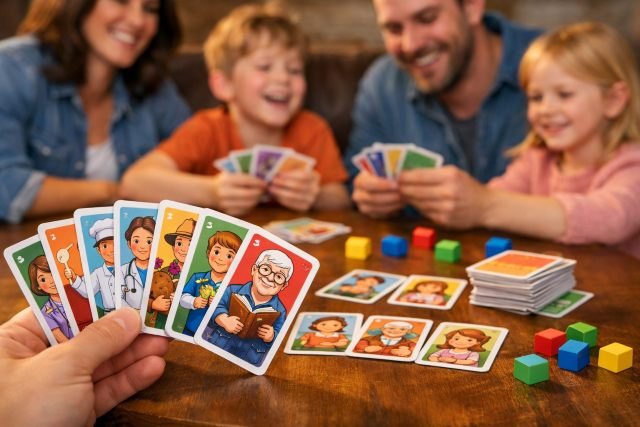
Family game nights are becoming increasingly important as families search for meaningful ways to spend time together away from screens. One classic option that continues to stand out is the happy families card game. This traditional card game combines simplicity, education, and genuine fun, making it an excellent choice for children and adults alike. Its timeless appeal lies in how effortlessly it brings people together while encouraging communication, learning, and laughter.
The happy families card game has remained popular for generations because it is easy to understand, quick to play, and suitable for a wide range of ages. Whether you are introducing young children to card games or looking for a lighthearted activity everyone can enjoy, this game fits perfectly into any family game night routine.
What Is the Happy Families Card Game?
The happy families card game is a traditional matching card game in which players aim to collect complete sets, known as families, by asking other players for specific cards. Each family usually consists of four related members, often represented as parents and children or characters linked by a shared theme.
The game is built around simple turn-based interaction. Players must remember which cards others may hold and ask clearly for what they need. This straightforward structure is one of the reasons the happy families card game remains so accessible and enjoyable for families today.
Why the Happy Families Card Game Is Perfect for Family Game Night
One of the strongest reasons the happy families card game works so well for family game night is how easy it is to learn. Children can understand the rules within minutes, and adults do not need to spend time reading long instruction manuals. This allows families to start playing almost immediately, which is especially helpful on busy evenings.
The game also encourages natural conversation. Players must speak directly to one another, listen carefully, and respond politely. This type of face-to-face interaction is increasingly valuable in modern households. According to the American Academy of Pediatrics, shared activities that involve communication help children develop social and emotional skills that support healthy relationships later in life.
Educational Benefits of the Happy Families Card Game
The happy families card game offers more than entertainment. It supports cognitive development in subtle but powerful ways. Children improve their memory by recalling which players asked for which cards. They develop logical thinking as they decide which card to request next, and they strengthen their ability to categorize information by grouping related cards into families.
Research published in Frontiers in Psychology highlights that structured play activities enhance memory, attention, and executive functioning in children. Games like happy families naturally incorporate these skills without making learning feel forced.
Language development is another key benefit. As children repeatedly ask for cards and hear consistent phrasing, they gain confidence in sentence structure and vocabulary. Many themed versions of the happy families card game also introduce new words related to animals, professions, or history, which further supports learning through play.
Why Parents Appreciate the Happy Families Card Game
Parents often value the happy families card game because it provides screen-free entertainment that still feels engaging. In a time when digital devices dominate leisure hours, sitting around a table with cards creates space for real connection. Families talk, laugh, and interact in ways that screens rarely encourage.
Common Sense Media reports that reducing recreational screen time can improve focus, sleep quality, and family relationships. These findings reinforce the value of traditional games during family downtime.
Another advantage is affordability. The happy families card game is typically inexpensive compared to many board games and requires no batteries or complicated setup. Its compact size also makes it ideal for travel, holidays, and spontaneous game nights.
Modern Versions and Variations
Although the happy families card game has traditional roots, modern versions keep it fresh and relevant. Today’s decks often feature creative themes such as animals, occupations, fictional characters, or educational topics. These variations allow parents to tailor the game to a child’s interests while maintaining the same familiar rules.
This flexibility makes the happy families card game a long-term addition to a family’s game collection rather than a novelty that quickly loses appeal.
Making the Most of Family Game Night
To enhance family game night, it helps to approach the happy families card game with a relaxed mindset. Focusing on enjoyment rather than competition ensures that younger players feel included and confident. Older family members can guide children gently, turning each round into a shared learning experience rather than a test of skill.
Establishing a regular game night routine also adds value. Even short sessions can become meaningful traditions that children look forward to each week. Over time, these moments strengthen family bonds and create lasting memories.
Families Card Game Compared to Other Games
Compared to more complex board games or fast-paced digital games, the happy families card game offers a calmer and more inclusive experience. It does not overwhelm younger players with complicated rules, and it avoids the intense competition that can sometimes lead to frustration. Instead, it creates an environment where learning and fun happen naturally together.
This balance is one of the reasons educators and parents continue to recommend the happy families card game as a foundational activity for children.
Frequently Asked Questions
Many parents ask whether the happy families card game is suitable for young children. The answer is yes. Most versions are appropriate for children aged four and above, especially with gentle guidance during the first few rounds.
Another common question is how long a game lasts. A typical round usually takes between ten and twenty minutes, making it easy to fit into evening routines. Families also wonder whether the game is educational, and research-backed evidence shows that it supports memory, language, and social development.
Conclusion
The happy families card game continues to be a perfect choice for family game night because it combines simplicity, education, and genuine connection. It encourages conversation, supports cognitive and language development, and provides a refreshing break from screens. Most importantly, it brings families together in a way that feels natural and enjoyable.
For families looking to create meaningful traditions and shared experiences, the happy families card game remains a timeless and valuable addition. Its ability to entertain while educating makes it just as relevant today as it was generations ago, proving that classic games still have a powerful place in modern family life.